Sustainability Determination of Material Issues
Marubun Group's material issues
We have identified five material issues that are essential to our sustainable growth. For each issue, we have established a key theme, a KGI (Long-term target states), and KPIs (Quantitative targets for FY2030) to quantitatively track progress, and we are advancing initiatives aimed at realizing a “a brighter future”.
Regarding KPIs, we view them as a crucial compass for clarifying our commitment to sustainability and objectively evaluating our progress. We translate these established metrics into concrete action plans for each department and are promoting measures to achieve our goals. By consistently implementing the PDCA cycle, reviewing our strategy as necessary, and regularly monitoring progress at Board of Directors meetings, we will enhance the effectiveness of our initiatives.
■Material Issues and Targets
| Material Issues | Key themes | KGIs(Long-term target states) | KPIs(Quantitative targets for FY2030) |
| Contribution to restoration and conservation of the global environment and to its sustainability | Promote initiatives for a recirculating society | As a milestone toward achieving carbon neutrality in or before 2050, reduce our in-house GHG emissions (Scopes 1 and 2) to less than 50% of the 2019 level by 2030. | • Reduce domestic Group greenhouse gas emissions (total of Scope 1 and Scope 2) by 50% by FY2030 compared with FY2019 levels. |
| Ensure all the industrial waste generated in our business activities is properly monitored and managed until it is completely recycled or disposed of. | • Percentage of cases handled by certified industrial waste disposal contractors: in principle 100% |
||
| Continue to be involved in and contribute to the promotion of the resource recycling systems that are needed by society through our business operations and investments. | • Promote resource recycling initiatives through businesses and investments by participating in organizations that contribute to the development of a circular economy. |
||
| Identify and introduce new clean technologies | Further expand ecologically sound product lines across consolidated business operations. | • Sales of ecologically sound products: 150% or more compared with FY2024 results. |
|
| Realization of a safe, prosperous and sustainable society | Expand activities to contribute to society and local communities | Promote and maintain support for developing the public good and contributing to organizations. | • Donation support amount: 125% or more compared with FY2024 results. |
| Continually encourage employees to participate in social action programs and contribution activities. | • Days of volunteer leave taken: 100 days or more per year across the Company. | ||
| Offer reliable products, services and stable supply chain infrastructure | All requests from customers regarding the quality and safety of our products and services are properly addressed. | • Response rate for chemical substance surveys and conflict minerals surveys: 100% |
|
| Fully obtain our suppliers’ understanding and cooperation with our Sustainable Procurement Guidelines. | • Rate of distribution of Supply Chain Sustainable Procurement Guidelines to suppliers: 100% |
||
| The enhancement of our operational infrastructure and the reliability of our client service operations is realized and maintained at high levels (i.e., our “operational excellence” is effectively achieved and sustained). | • Number of service nonconformities attributable to the Company: zero | ||
| Enhancement of human capital strategies in alignment with our Purpose | Strengthen programs for talent acquisition and development to constitute a highly professional group of employees | Human capital strategies consistent with our Purpose and our business strategies are properly defined for their implementation, and all relevant human capital management measures are effectively implemented. | • Percentage of employees who have a solid understanding of the Group’s philosophy framework and financial targets: 100% |
| Support programs for autonomous career development and the cultivation of human resources are effectively designed, established and functioning. | • Annual training hours per employee: 120% or more compared with FY2024 results. | ||
| Consistently improve employee engagement | Continuously enhance employee engagement through various human capital strategies and HR measures. | • Employee engagement survey score: 3.75 or higher (on a 5-point scale) • Three-year effective retention rate for new employees: 100% |
|
| Our Employee Net Promoter Score is always greater than the average for the wholesale industry category that we operate within. | • eNPS score exceeds the wholesale/retail industry average and is in the -40 range or higher |
||
| Encourage the empowerment and promotion of employees that are women | Ensure employees that are women are 15% or more of our management-level employees. | • Ratio of women in managerial positions exceeds the peer company average and is 15% or higher. |
|
| Establishment and administration of a solidified group governance framework | Continuously improve stakeholder engagement | Engagement opportunities for our shareholders and investors are sufficiently offered. | • Number of visits to the shareholder and investor information website: 115% or more compared with FY2024 results. |
| Through the improvement of IR events and tools, the quality and quantity of the information we disclose is continuously reviewed, and a high reputation is objectively and comparatively established among our stakeholders. | • Receipt of award in IR website rankings by evaluation organizations. | ||
| Reinforce the compliance of all Group companies | Throughout our consolidated Group businesses, all legal and policy compliance is thoroughly ensured. (We have absolutely zero recognized compliance violation incidents outstanding). | • Participation rate in compliance training for the domestic Group: 100% • Number of “major compliance violations”: zero |
|
| Continuously enhance strategy management and risk management frameworks | Business plans at the Group level are institutionally decided and reviewed in timely manner in light of macroeconomic trends, and the Group’s strategic directions are articulately communicated both internally and externally. | • Achievement of the Group’s Medium-Term Business Plan and its ordinary profit targets. | |
| The Group’s strategic directions and measures are compatible with the management plans of each business unit as well as with each individual employee’s goal setting (via Management by Objectives), and the PDCAcycle is organically and consistently functioning at all levels. | |||
| Integrated risk management is functioning at a high level for the early detection and correction of any specific risk elements or incidents. | • Number of “major risk events”: zero | ||
| IT systems infrastructure, which is the foundation for managing information, is maintained stably and operated effectively. | • Number of “major IT incidents”: zero | ||
| Addressing social issues through the development of cutting-edge technologies and solutions | Staying ahead of the change in the demand generated by society, introduce products and services with new added value | Continue to cultivate, identify and deliver products and services with new added value, by way of exploring new potential value for society. | • Sales in the medical/healthcare field: 150% or more compared with FY2024 results. |
| Solve customers’ issues by offering solutions as an electronics trading company | By effectively capturing customers’ concerns and needs, continue to offer measures to respond to customer’s by leveraging solution development and technological capabilities. | • Frequency of customer contact through Company-designated media: 120% or more compared with FY2024 results. |
|
| Initiate innovation through strategic partnerships and collaborations | Products and services in a new scope of business and new business domains created through strategic partnerships and collaborations are contributing to the expansion of business and the growth of the revenue of the Group. | • Increase in the number of products handled and profit growth in new business areas created through business alliances and collaboration. |
The materiality identification process
STEP1.Creation of a long list of candidate social issues
The social themes/issues that should be taken into consideration for the Group’s sustainable growth (candidate material issues) were initially identified from, for example, international guidelines and sustainability evaluation institutions’ material issues and benchmarks.
We identified social issues (materiality candidates) that should be taken into account for the sustainable growth of our Group, on the basis of international guidelines (GRI Standards, SASB), the material issues of sustainability rating agencies (MSCI), benchmarks (JPX ESG), and other inputs.
STEP2.Narrowing down based on Marubun’s businesses
We narrowed down the identified social issues based on those that our departments are tackling through their work, and on directions that should be prioritized in the medium and long term.
STEP3.Evaluation by internal and external stakeholders
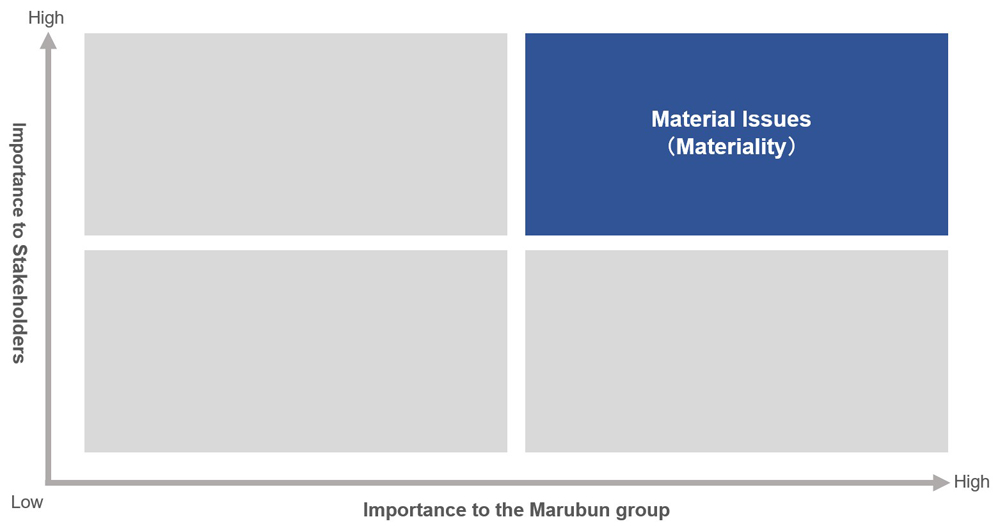
We comprehensively evaluated the importance of the materiality candidates by consolidating opinions from executive directors, outside directors, executive officers, presidents of subsidiaries, and other parties along the two axes of importance to the Group and importance to stakeholders.
We extracted 18 items that we should prioritize.
STEP4.Reorganization of material issues and determination of final draft
We reorganized and grouped 18 materiality items from the perspective of the environment, society, human capital, governance, and our Company, and decided on a final materiality draft with five items.
We set key themes that connect to specific initiatives, and decided on a draft list of KGIs.
STEP5.Identification of material issues
After confirmation of the final draft by the Sustainability Committee and resolution by the Board of Directors, we identified our material issues.